Peter Schofield's Reviews
  • Home Page
  • RecentbReviews and Previews
  • Composer Index
    • Adams >
      • Nixon in China
    • Ades, The Tempest
    • Albinone, Pimpinone
    • Arne >
      • Artaxerxes
    • Bartok
    • Beethoven >
      • Fidelio
    • Bellini >
      • Norma
      • I Puritani
      • La Sonnambula
    • Berg >
      • Lulu
      • Wozzeck
    • Berlioz >
      • Beartrice et Benedict
      • Benvenuto Cellini
      • Damnation de Faust
      • Les Troyens
    • Birtwistle >
      • Minotaur
    • Bizet >
      • Carmen
    • Borodin >
      • Prince Igor
    • Britten >
      • Death in Venice
      • Peter Grimes
      • The Rape of Lucretia
      • Turn of the Screw
    • Cavalli >
      • La Callisto
      • Erismena
    • Debussy >
      • Peleas et Melisande
    • Donizetti >
      • Anna Bolena
      • Don Pasquale
      • L'Elisir d'Amore
      • Fille du Regiment
      • Lucia di Lammermoor
      • Maria Stuarda
      • Poliuto
      • Roberto Devereux
    • Dvorak >
      • Rusalka
    • Giordano
    • Glass >
      • The Fall of the House of Usher
    • Gluck >
      • Iphigenie en Aulide
      • Iphigenie en Tauride
      • Orpheus and Eurydice
    • Gounod >
      • Romeo et Juliette
    • Handel >
      • Acis and Galatea
      • Agrippina
      • Apollo e Dafne
      • Esther
      • Giulio Cesare in Egitto
      • Jephtha
      • Hercules
      • Orlando
      • Partenope
      • Radamisto
      • Rinaldo
      • Rodelinda
      • Saul
      • New Page
      • Tamerlano
      • Theodora
      • Xerxes
    • Haydn >
      • Arianna auf Naxos
      • La Canterina
      • L'Infidelta Delusa
    • Janáček >
      • Jenufa
    • LeGendre >
      • Burial at Thebes
    • MacMillan >
      • The Sacrifice
    • Martinu >
      • Mirandolina
    • Massenet >
      • Thais
    • Monteverdi >
      • Coronation of Poppea
      • Ritorno d'Ulisse in Patria
    • Moussorgski/Shostakovich >
      • THe Khovanski Affair
    • Mozart >
      • Cosi fan tutte
      • Die Entfuhrung aus dem Serail
      • Don Giovanni
      • Idomeneo
      • La Clemenza di Tito
      • Le Nozze di Figaro
    • Offenbach >
      • Die Schone Helena >
        • Die Schone Helena
      • Les Contes d'Hoffmann
      • Vert-Vert
    • Prokofiev >
      • The Gambler
    • Puccini >
      • La Boheme
      • La Fanciulla del West
      • Madama Butterfly
      • La Rondine
      • Tosca
      • Turandot
    • Rameau >
      • Hippolyte et Aricie
      • Platee
      • Zoroastre
    • Rossini >
      • Barber of Seville
      • Armide
      • La Cenerentola
      • Le Conte Ory
      • La Donna del Lago
      • Mose in Egitto
      • Guillaume Tell
    • Rushton >
      • The Shops
    • Saariaho:
    • Salieri >
      • La locandiera
    • Schonberg
    • Shostakovich
    • Stradella >
      • Salome
    • Strauss JH
    • Strauss R >
      • Ariadne auf Naxos
      • Capriccio
      • Die Frau Ohne Schatten
      • Intermezzo
      • Die Rosenkavalier
      • Elektra
      • Salome
    • Tchaikowsky >
      • Eugene Onegin
      • Iolanta
      • Mazepa
      • Queen of Spades
    • Thomas >
      • Hamlet
    • Verdi >
      • Aida
      • Don Carlo
      • Ernani
      • Falstaff
      • Giovanna d'Arco
      • Macbeth
      • I Due Foscaari
      • Nabucco
      • Otello
      • Rigoletto
      • Simon Boccanegra
      • La Traviata
      • Il Trovatore
    • Vivaldi >
      • L'Incoronazione di Dario
    • Wagner >
      • Das Rheingold
      • Die Walkure
      • Flying Dutchman
      • Gotterdammerung
      • Meistersinger
      • Parsifal
      • Lohengrin
      • Tristan und Isolde
      • Tannhauser
    • Walton
    • Weber >
      • Der Freischutz
    • Weill
    • Zambiurai
  • The MET in HD
    • Prologue - Joseph Volpe
    • Reviews by Date >
      • Eugene Onegin 24/02/2007
      • Roméo et Juliette 15/12/2007
      • Tristan und Isolde 22/03/2008
      • La Damnation de Faust 22/11/2008
      • Thaïs 20/12/2008
      • La Rondine 10/01/2009
      • Orfeo ed Euridice 24/01/2209
      • La Somnambula 21/03/2009
      • Aida 26/10/2009
      • Les Contes d’Hoffmann 19/12/2009
      • Der Rosenkavalier 15/12/2009 and 09/01/2010
      • Simon Boccanegra 06/02/2010
      • Hamlet 17/03/2010
      • Armida 01/05/2010
      • Das Rheingold 09/10/2010
      • Boris Godunov 24/10/2010
      • Don Carlo 12/12/2010
      • La Fanciulla del West 09/01/2011
      • Nixon in China 12/02/2011
      • Lucia di Lammermoor and Le Comte Ory 27/03/2011 and 10/04/2011
      • Capriccio 24/04/2011
      • Die Walküre 15/05/2011
      • Anna Bolena 16/10/2011
      • Rodelinda 04/12/2011
      • Ernani 26/02/2012
      • Otello 30/10/12, The Tempest 13/11/13
      • La Clemenza di Tito (4.12.2012
      • Troyens 9/01/2013
      • Maria Stuarda 22/01/2013
      • Rigoletto 19/02/13
      • Parsifal 05/03/13
      • Francesca da Rimini 19/03/13
      • Eugene Onegin 08/10/2013 >
        • I Puritani
      • The Nose 29.102013
      • Prince Igor 04/03/2014
      • Werther 18/03/2014
      • La Cenerentola 13.05.14
      • Macbeth 14/10/2014
      • Meistersinger 16.12 14
      • Iolnta, Bluebeard's Castle 17.02.15
      • La Donna del Lago 07.03.15
      • Il Trovatore 3.06 2015
      • Otello 20.10.2015
      • Tabbhauser 31.10.2015
      • Lulu 24/11/2015
      • Madam Butterfly
      • Elektra
      • Tristan und Isolde 11.10.2016
    • Reviews by Opera >
      • Aida
      • Anna Bolena
      • Die Walküre
      • Boris Godunov
      • Capriccio
      • Das Rheingold
      • Der Rosenkavalier
      • Don Carlo
      • Ernani
      • Eugene Onegin
      • Hamlet
      • La Cenetrentola
      • La Clemenza di Tito
      • La Damnation de Faust
      • La Fanciulla del West
      • La Rondine
      • La Somnambula
      • Les Contes d’Hoffmann
      • Lucia di Lammermoor and Le Comte Ory
      • Maria Stuarda
      • Nixon in China
      • Orfeo ed Euridice
      • Rodelinda
      • Roméo et Juliette >
        • Improbable
      • Simon Boccanegra
      • Thaïs
      • Tristan und Isolde
      • Troyens
  • Glyndebourne
    • 2016 Beatrice et Benedict Saul
    • 2015 - Poliuto
    • Rape of Lucretia
    • 2014 - DervRosenkavalier, La Traviata
    • 2013 Hippolyte et Aricie, Ariadne auf Naxos, Don Pasquale >
      • 2009 - Rusalka
    • 2012 - Cunning Little Vixen
    • 2011 - Rinaldo
    • 2010 - Don Giovanni
    • 2007 - Macbeth
    • Garsington Opera >
      • Mirandolina
      • L'Italiana in Algeri
      • L'Incoronazione di Dario
      • Armide
      • Offenbach: Vert-vert
      • Intermezzo
    • 2006 Cosi fan Tutte
    • 2008 - Poppea
    • 2005 - Giulio Cesare
    • 2002 - Iphegenia in Aulide
    • Glyndebourne on Tour
    • Die Entfuhrung
  • Buxton
  • ROH Covent Garden
    • ROH Ariadne auf Naxos
    • ROH Callisto
    • ROH Carmen
    • ROH Don Giovanni
    • ROH La Donna del Lago
    • ROH Duke Bluebeard's Castle
    • ROH Erwartung
    • ROH Eugene Onegin
    • ROH Fille du Regiment
    • ROH Lohengrin
    • ROH The Gambler
    • ROH Mahagonny
    • ROH Minotaur
    • ROH Le Nozze di Figaro
    • ROH Peleas et Melisande
    • ROH Rosenkavalier
    • ROH Wozzeck
  • ENO London Coliseum
    • Agrippina
    • Benvenuto Cellini
    • Carmen
    • Partenope
  • Opera North
  • Welsh National Opera
    • Don Giovanni
    • Eugene Onegin
    • Fidelio
    • Flying Dutchman
    • Guillaume Tell
    • Iphigenie en Tauride
    • Khovansky Affair
    • Lohengrin
    • Lulu
    • Manon Lescaut
    • Mazepa
    • Mose in Egitto
    • Orlando
    • Otello
    • Parsifal
    • I Puritani
    • The Sacrifice
    • Tristan >
      • Traviata
    • Tudor Operas
    • Wozzeck
  • Ellen Kent
    • Aida
    • La Boheme
    • Carmen
    • Die Fledermaus
    • Madam Butterfly
    • Rigoletto
    • La Traviata 2005
    • La Traviata 2015
    • Tosca
  • New Chamber Opera
    • Pompinone
    • L'Infidelta Delusa
    • Tamurlano
    • La Locandiera
  • Other Companies
    • Bampton Classical Opera
    • Improbable
    • Opera Anywhere
    • OU Theatron Novum
    • The Opera Group
    • OperaUpClose
    • Oxford Philomusica
  • Locations
    • Baugé en Anjou
    • Budapest and Vienna
    • Dresden
    • Hamburg
    • London
    • Milan
    • Munich
    • Oxford >
      • Oxford Lieder
      • Oxford Philomusica
      • Chamber Music Festivals
    • Paris
    • Riga
    • Sweden >
      • Drottningholm, Confidencen
      • Opera pa Skaret
      • Stockholm
    • Toulouse
    • Vienna State Opera
  • Concerts and Recitals
    • IT&T
    • Music at Oxford
    • SJE Piano series
    • Humanitas 2016
    • Oxford Lieder >
      • Singing words 2015
      • The Schubert Project, 2014
      • The Schumann Project 2016
      • Young Artist Platform 2011
      • Young Artist Platform 2013
      • Oxford Lieder Festival 2013
      • Oxford -Lieder Festival 2012
      • Oxford Lieder Festival 2011
      • Oxford-Lieder Festival 2010
      • Oxford Lieder 2009
      • L'Italiana in Algeri
      • Oxford Lieder 2008 >
        • Don Giovanni 26.10 2016
      • Oxford Lieder 2007
      • Oxford Lieder 2006
      • Oxford Lieder 2005
    • Oxford Chamber Music Festival
    • Oxford Chamber Music Society
    • Oxford Early Music Festival
    • OSJ Ashmole
    • Oxford May Music
    • Phantasm
    • Southwell Music Festival
    • Stradivarius
  • Book Reviews
    • Mozart
    • Phoenix
    • Trade Secrets
    • Opera History
    • Volpe
    • Wagner
  • History in Opera
  • Christmas Card
  • Untitled
  • Untitled
  • Die Fledermaus
  • New Page
  • Untitled
  • New Page
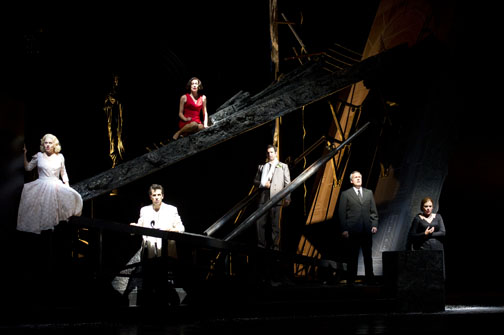
Picture
Photo -B ill Cooper

WA Mozart: Don Giovanni, Glyndebourne, 4 July, Drottningholms Slottsteater, Sweden, 28 August 2010.

We were warned! In a Radio Three interview shortly before the opening performance of Glyndebourne’s new production of Don Giovanni, the conductor Vladimir Jurowski said that this was one of the greatest of all operas because of its eclecticism, not only looking back to opera seria but forward to the grand operas and music dramas of the nineteenth century if not also to the post Wagnerian period.  This misguided attitude pervaded the whole production. One cannot deny that it was dramatic! The house lights were suddenly extinguished and the two opening chords of the overture immediately sounded with exaggerated portentousness with little concession to the period sound expected from the Orchestra of the Age of Enlightenment. The overture set the scene for a performance very dark in mood and illumination aiming at a brutal realism stripping away from the story the veneer of opera buffa (dramma giocosa), the creation of Mozart and da Ponte. Act I opened with Leporello on guard (apparently in underpants). Donna Anna rushes on crying ‘Rape’, having found herself in bed with a stranger, followed by the Commendatore, her father, who is sadistically battered to death by Giovanni, rather than being run through with a sword. And so it went on – the party scene was orgiastic with hints of sado-masochism. The statue appears as a decaying corpse; the cathartic sextet at the end when each character looks forward to the future is marred by having Giovanni’s corpse receiving kicks at the front of the stage, despite having been consigned to Hell moments before. (The flames of Hell were transposed spectacularly but, for no other apparent reason, to the end of Act I.) This is Don Giovanni as verismo opera seen through puritanical eyes where, beneath the surface, there is no distinction between seduction and rape and, in the catalogue of his many conquests, no indication that any of the ladies might actually have enjoyed the experience.

The reader will gather that I disliked this production. To be fair I should say that few I have spoken to agree with me. But how about the staging and performance? Most remarkable is the set design of Paul Brown. The basic element is a rotating cubic representation of a renaissance town house (a companion identified it as the Palazzo dei Diamanti in Ferrara) with the front door opening up for Zerlina and friends, as a chapel where the Commendatore’s coffin lies in the scene where Anna, Ottavio and Elvira take stock of the situation (an innovation reminding of Puccini), and Giovanni’s party. Filling the back wall of the house appear ‘significant’ pictures, first of Mary Magdalene and then a scene of pastiche baroque debauchery. In the second Act the set is more like an expressionist movie, with several levels leading down to a trapdoor and basement where Leporello, disguised as his master, is tied up and lowered. It is difficult to figure this out.

This production gives little opportunity for the singers to develop the subtleties of their characters. It did not help that the lighting was so dim. Gerald Finley as the Don is unusually uncharismatic; Leporello (Luc Pisaroni) makes the most of the few opportunities for humour which remain. Ottavio (William Burden) left little impression. Guido Lonconsolo plays Masetto. Of the ladies, the Zerlina of Anna Virovlansky is the most lively, Anna (Anna Samuil) has a fine powerful voice but little personality, while Kate Royal as Elvira disappoints, failing to contrast the contradictions of her feelings.

The Director is Jonathan Kent. To produce Don Giovanni as verismo opera is an interesting innovation but only serves to emphasise the subtlety, humanity and humour of the original concept of Mozart and da Ponte where the evil charm of the Don is implied through his relation to Leporello and the three ladies.


***

By contrast, this year’s production of the same opera at the exquisite baroque theatre at Drottningholm Palace on the outskirts of Stockholm, while introducing a modern twist to the interpretation, was totally true in spirit to the original. This is the third Drottningholm collaboration of the director Johanna Garpe with Drottningholm’s Artistic Director, conductor Mark Tatlow. Previously we have reported Monteverdi Il Ritorno d’Ulisse in Patria in 2008 (OM No.279) and L’Incoronazione di Poppea last year (OM NO.291), both of which illustrated a similar modern freshness of approach. Her basic idea this time is to set the story in the context of the eve of the impending French Revolution, exaggerating the age, class and social standing of the protagonists. Thus Don Giovanni and Leporello are depicted as decrepit oldies (a little too decrepit for dramatic sense), the Don belonging to a doomed aristocracy, Anna, Elvira and Ottavio are outraged members of the bourgeoisie (ultimately invoking the powers of law and order who arrive too late to arrest Don Giovanni at the end), while Zerlina, Masetto and companions are young tearaways. This was neatly illustrated at the end of the first act when Giovanni emerges from his failed attempt to ravish Zerlina, still in command of the situation when confronted by the masked trio who are delicately picking their way between the sprawling bodies of the young people who have overindulged at the party. This stratification made sense of Zerlina’s relationship with Giovanni. What young girl has not at some time been flattered by the attentions of an elderly gentleman, unaware of his lecherous intent?

After a rather ragged performance of the Overture, the orchestra of period instruments settled down to provide a firm accompaniment to a fine group of singers, conducted from the keyboard of a large, impressively sonorous fortepiano (a modern copy of a late 18th century instrument by Schantz). Particularly impressive were Marika Schönberg as a passionate and vindictive Donna Anna and Lars Arvidson, living the part of Leporello. Also deserving their warm applause were the well-rounded Donna Elvira of Miriam Treichl and the unusually robust Don Ottavio of Magnus Staveland (for once one could even believe he and Anna might eventually get together). Recent opera school graduate Susanna Stern sang Zerlina with remnants of a ‘Vadstena screech’, a shrill edge to the voice which I have noted before in fledgling Swedish sopranos and named after the opera academy there. Bass-baritone Håvard Stensvold doubled the roles of Masetto and Commendatore, probably for reasons of economy – the vocal requirements are not compatible. Carl Johan Loa Falkman relied on dramatic ability rather than outstanding vocal quality in his portrayal of Don Giovanni but this did not impair our enjoyment of the whole performance.

For once the temperature in the auditorium was not unbearable nor did the seats seem intolerably uncomfortable. A minor distraction was the filming of the performance for future TV presentation, which incongruously involved a cameraman gliding back and forth across the front of the orchestra followed by a small girl reeling in and out his cable.

Powered by Create your own unique website with customizable templates.