Tudor Times
Gaetano Donizetti: Anna Bolena, Maria Stuarda, Roberto
Devereux, Welsh National Opera, New Theatre, Oxford, 16-18 October 2013.
As part of the revitalisation of the Welsh National Opera’s repertoire by its Artistic Director David Pountney introducing themes of related operas, an ambitious project has been the staging, on successive nights, of Donizetti’s three Tudor operas based on historical events of the sixteenth century. Rather than being historically accurate, they can be regarded as how the popular press of the day might have covered the events leading up to the executions of Anne Boleyn, Mary Queen of Scots and Robert Devereux, Earl of Essex with added ‘human interest’ as reported respectively by Alessandro Pepoli, Enrico VIII, by Schiller Maria Stuart and by François Ancelot Elizabeth d’Angleterre.
Anna Bolena concerns Anne’s replacement in the affections of Henry VIII (Enrico) by her lady-in waiting Jane (Giovanna) Seymour, with evidence suggesting Anna’s adultery providing an excuse for her trial and beheading. The key scene is a long duet between Anna and Giovanna where Anna confides her fears to Giovanna, not suspecting that Giovanna is her rival as finally revealed.
As part of the revitalisation of the Welsh National Opera’s repertoire by its Artistic Director David Pountney introducing themes of related operas, an ambitious project has been the staging, on successive nights, of Donizetti’s three Tudor operas based on historical events of the sixteenth century. Rather than being historically accurate, they can be regarded as how the popular press of the day might have covered the events leading up to the executions of Anne Boleyn, Mary Queen of Scots and Robert Devereux, Earl of Essex with added ‘human interest’ as reported respectively by Alessandro Pepoli, Enrico VIII, by Schiller Maria Stuart and by François Ancelot Elizabeth d’Angleterre.
Anna Bolena concerns Anne’s replacement in the affections of Henry VIII (Enrico) by her lady-in waiting Jane (Giovanna) Seymour, with evidence suggesting Anna’s adultery providing an excuse for her trial and beheading. The key scene is a long duet between Anna and Giovanna where Anna confides her fears to Giovanna, not suspecting that Giovanna is her rival as finally revealed.
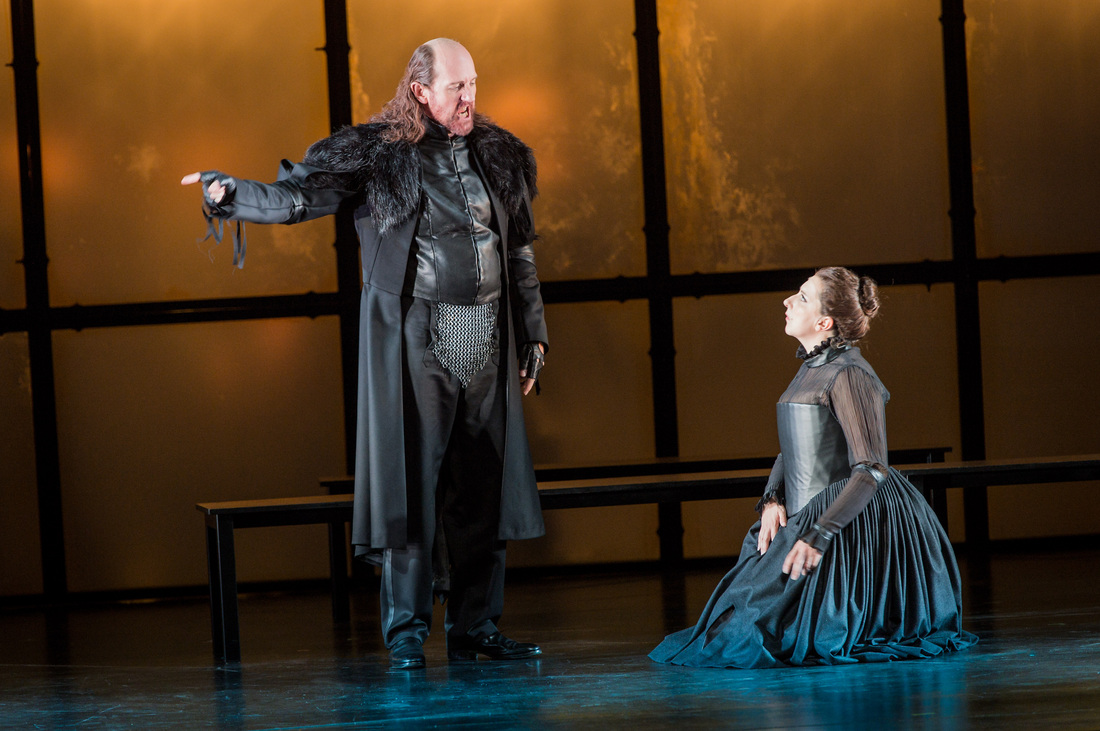
- Alastair Miles (Henry VIII) and Serena Farnocchia (Anne Boleyn) credit Robert Workman 157_0
Maria Stuarda centres on a fictional meeting between
her and Queen Elizabeth (Elisabetta), engineered by Maria’s catholic supporter
Talbot and Roberto Earl of Leicester, who loves her but is secretly loved by Elisabetta.
Although urged, by her supporters to stay calm and show courtesy to Elisabetta,
Maria flips and provokes a cat-fight with an exchange of insults unequalled in
opera (by far surpassing Susanna and Marcellina in Figaro). This seals her fate
and Roberto is forced to witness her execution.
Towards the end of Elizabeth’s reign. Devereux, her last lover, has been accused of treason. Elisabetta’s attempts to save him are thrown into confusion when she learns that he has been having an affair with Sara, Duchess of Nottingham, a confidante of the Queen. Devereux is executed.
These WNO productions are doubly ambitious. Not only do they require six exceptional soprano voices and a large contingent of bel canto male singers of similar calibre but also because they are in contention for Oxford audiences with The NY Metropolitan Opera’s recent HD transmissions at the Phoenix Picturehouse of Anna Bolena in 2011 and Maria Stuarda in January this year with Roberto Devereux to follow. Not expecting a match for Anna Netrebko as Anna or for Joyce DiDonato’s definitive portrayal of Maria Stuarda, nevertheless we heard three pairs of thrilling powerful ladies in Serena Farnoccia and Katharine Goeldner as Anna and Giovanna, Judith Howarth and Adina Nitescu as Maria and Elisabetta, Alexandra Deshortie and Leah –Marian Jones as Elisabetta and Sara, each capable of soaring over the full WNO chorus – no mean feat! Anne Boleyn and the aging Elizabeth in the third opera were outstanding. However the cat-fight in no way resembled the viciousness of that between DiDonato and Elza van den Heever at The Met.
Towards the end of Elizabeth’s reign. Devereux, her last lover, has been accused of treason. Elisabetta’s attempts to save him are thrown into confusion when she learns that he has been having an affair with Sara, Duchess of Nottingham, a confidante of the Queen. Devereux is executed.
These WNO productions are doubly ambitious. Not only do they require six exceptional soprano voices and a large contingent of bel canto male singers of similar calibre but also because they are in contention for Oxford audiences with The NY Metropolitan Opera’s recent HD transmissions at the Phoenix Picturehouse of Anna Bolena in 2011 and Maria Stuarda in January this year with Roberto Devereux to follow. Not expecting a match for Anna Netrebko as Anna or for Joyce DiDonato’s definitive portrayal of Maria Stuarda, nevertheless we heard three pairs of thrilling powerful ladies in Serena Farnoccia and Katharine Goeldner as Anna and Giovanna, Judith Howarth and Adina Nitescu as Maria and Elisabetta, Alexandra Deshortie and Leah –Marian Jones as Elisabetta and Sara, each capable of soaring over the full WNO chorus – no mean feat! Anne Boleyn and the aging Elizabeth in the third opera were outstanding. However the cat-fight in no way resembled the viciousness of that between DiDonato and Elza van den Heever at The Met.
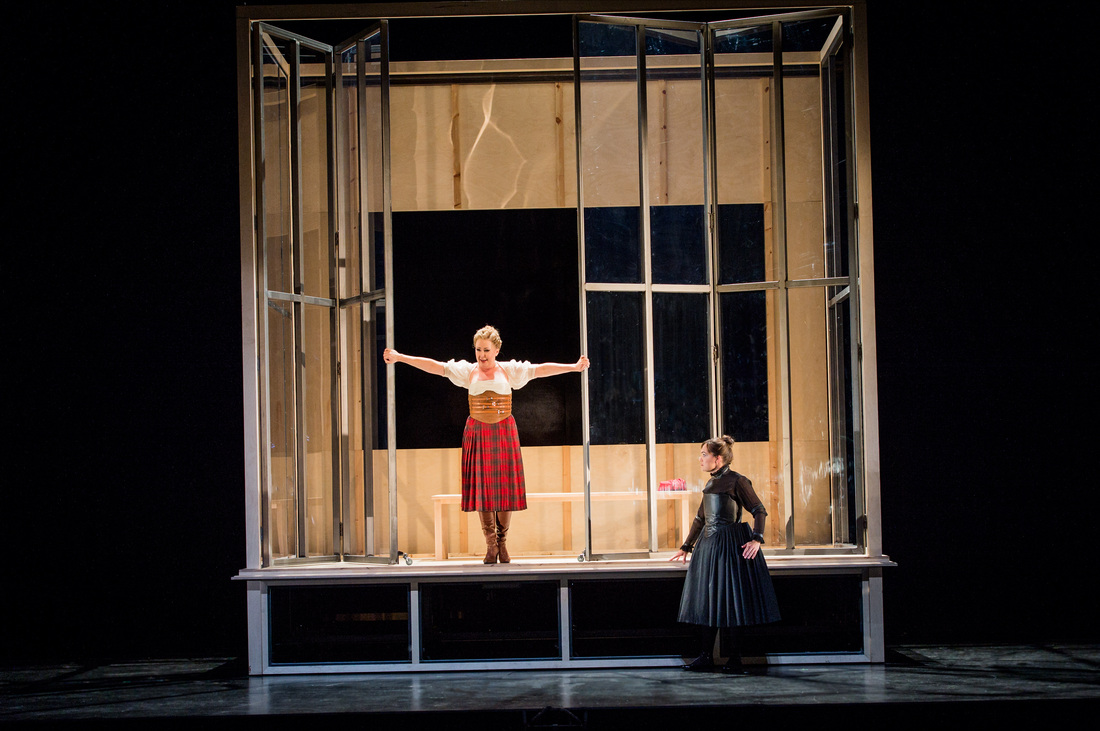
Maria Stuarda - Judith Howarth (Mary Stuart) and Rebecca Afonwy-Jones (Anna Kennedy) credit Robert Workman -086
The conductor on the first and third nights was an
extrovert young Italian Daniele Rustione who conducted the overtures with such
energy that we wondered if he would stay the course, winning a prolonged
ovation for Roberto Devereux. He transported us from the discomfort of Oxford’s
New Theatre to the discomfort of a provincial Italian opera house. Maria
Stuarda was conducted more sedately, though almost equally effectively, by
Graeme Jenkins. Of the male roles: In Anna Bolena, Robert McPherson as Anna’s
ex-lover Lord Percy stood out for his bel canto tenor line though with a slight
metallic timbre but outstanding was Alastair Miles as Henry VIII. Here was a
king one could believe in as taking on the Church to marry Anne, yet capable of
tenderness (this in contrast to The Met production where he appeared weak and
susceptible to women’s charms). Miles appeared again as Talbot in an equally
impressive performance. In Roberto Devereux, Leonardo Capalbo sang and acted
completely convincingly in the title role leaving us with a real feeling for
what it must be like to be under sentence of death yet still clutching at
straws.
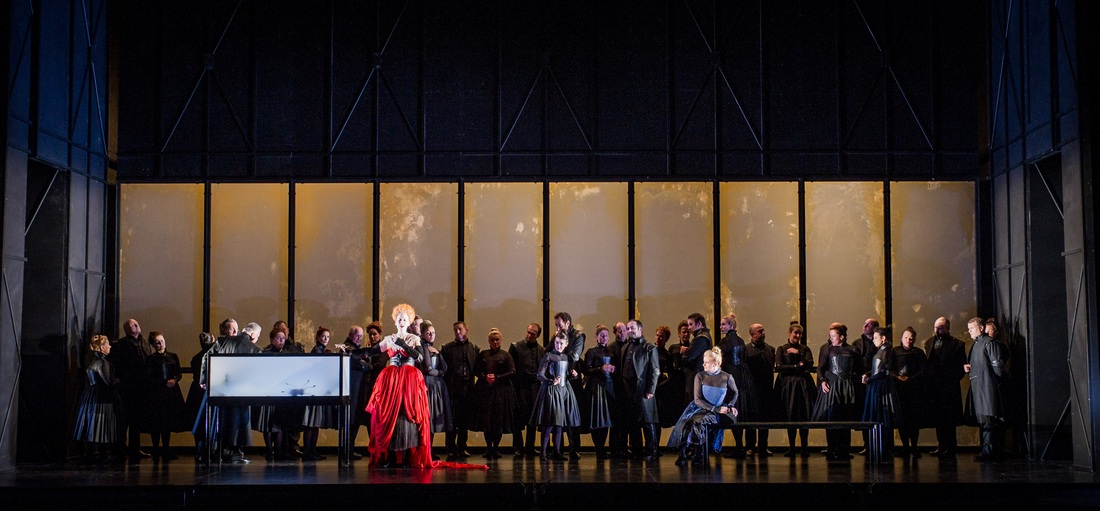
Roberto Devereux - Alexandra Deshorties (Elizabeth), Leah-Marian Jones (Sarah) & Chorus photo credit Robert Workman 071 (2)
Taken
together these three performances formed an unforgettable musical feast. This was in spite of the direction, design
and lighting which were uniformly appalling and unimaginative. The sets,
designed by Madeleine Boyd contained, for the most part the same elements of
various translucent screens dividing the
stage, before and behind which the cast, identically dressed in black
costumes, except occasionally in inappropriate bright colours either sat or
moved awkwardly. The lighting design of Matthew Haskins left most of the stage
in darkness, worst in Anna Bolena where the only way of distinguishing the
players was by voice, height and facial hair; the only time one could see their
faces was during the curtain –call. (The only explanation I could think of was
that the lighting director for the tour Ian Jones had not familiarised himself
with the theatre but the other operas were no better.) Whenever the production
departed from this drab presentation, the results were greeted with laughter or
deserving of boos. In Anna Bolena, Anna went to her death in an elaborate red
robe. In Maria Stuarda, Maria, absurdly dressed in a mid-calf tartan skirt,
shared a cigarette with her companion (Sir Walter Raleigh does not appear
before the third opera) while awaiting Elisabetta at Fotheringay outside an
Ikea furnished veranda which looked like an advertisement for patio doors. In a
crass scene towards the end, Maria removes her stockings to have her feet
washed by Talbot and then goes to the block with shoulder-length blond hair. In
Roberto Devereux, Elizabetta mounts an elaborate spider-like metal frame,
obviously ntended to symbolise something. In the absence from
the programme of a Director’s apologia, one has no idea what.
Fortunately Donizetti is strong enough to survive such
absurdities but WNO does need to be more careful in its choice of directors.
Nevertheless on each evening the curtain fell to a deserved ovation for the
singers, conductors and orchestra and we went home enriched.
