Oxford Early Music Festival
click for website
Oxford Early Music Festival 2015
Claudio
Monteverdi, Vespers (1610),
University Church of St Mary the Virgin, 15 May; François Couperin, Trois Leçons de Ténèbres, Magdelen
College Chapel, 16 May; The Rise of the
‘Loud Tenor’, Worcester College Chapel, 17 May 2015
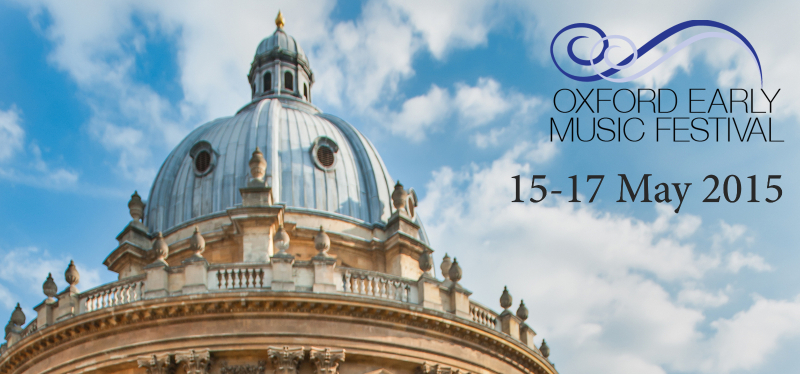
The 2015
Oxford Early Music Festival was held over the weekend 15-17 May. It opened on
the Friday with a rare opportunity to experience a production of Claudio
Monteverdi’s Vespers of 1610 in the
University Church of St Mary the Virgin. Due to start at 7.30 pm, before the
doors opened at 7.00 there was a long queue stretching down the High Street in
anticipatory mood, eventually packing the Church for a performance which
exceeded all expectation. Under the direction of Daniel Hyde who is involved in
most of the music-making at Magdalen College. For this occasion he had
assembled a remarkable collection of singers and instrumentalists to produce,
in effect, a semi-staged realisation of the work with carefully choreographed
entrances and positioning of soloists and choirs for solemn pacing of the music
and for dramatic effect exploiting the acoustics of the Church.
The soloists were sopranos Emily van Elvera and Cecilia Osmond, tenor Nicholas Mulroy, and tenor and bass parts sung by Nick Pritchard, Giles Underwood and Edward Grint, The choral singers were Ensemble 45, members of Magdalen College Chapel Choir and Frideswide Voices, established in 2014to enable girls aged between seven and fourteen to join in liturgical singing in Oxford College Chapels. The instrumentalists were the strings and continuo of the International Baroque Players including Daniel Maw organ and Richard Mackenzie theorbo and the three cornets and three sackbuts of the English Cornett and Sackbut Ensemble. These forces combined with their variation in positioning allowed a wide variety of timbres and textures to each number in the Vespers.
Vespro della beata Vergine to give the full title, were written by Monteverdi to enable him to escape from the straight-jacket of the Court at Mantua. Rejected by the Pope in Rome they successfully won the composer a place at St Mark’s in Venice where he spent the remainder of his career. The work consists of twelve numbers, verses from the psalms and the Song of Songs alternating with motets, followed by a setting for seven voices of the Magnificat in twelve parts. The performance started with a solo tenor declaiming from the pulpit the words Deus, in adjutorium meum intende …. all the more impressive for the strain it puts on the lowest notes of the tenor register, leading into the first full chorus. We were totally gripped until an artificial interval with drinks interrupted proceedings, soon after we had heard a divine Audi coelom with a second tenor echoing the first from behind the screen – not St Mark’s perhaps with its breadth of space but a first approximation. After the interruption, before the Magnificat we heard the ethereal young voices of Magdalen and Frideswide in Sonata sopra Sancta Maria and Ave Maris Stella.
***
Saturday’s programme opened with a Festival Evensong, accompanied by the consort of viols Phantasm, to a packed Magdalen College Chapel. This was followed by an organ recital of music by JS Bach given by John Butt in The Queen’s College. Later in the evening, back in Magdalen College Chapel sopranos Emily Atkinson and Esther Brazil accompanied by a continuo group of bass viol, lute and chamber organ from Oxford Baroque performed Trois Leçons de Ténèbres by François Couperin. These three works, settings of verses from Lamentations I, written as part of Holy Week services, the only survivors of a set of nine, provided an indescribably beautiful experience in the atmosphere of the candle-lit Chapel. Contrasted in nature we noted particularly the florid opening to the solo second and the close harmony – surprisingly modern - of the two voices in the third of the Leçons.
The Couperin was the only music from the eighteenth century in the Festival and was a good illustration of a transition from ‘early’ to ‘baroque’ music. On the Sunday lunchtime we were back in the seventeenth century in a packed small Worcester College Chapel. Tenor Nicholas Mulroy, more comfortable than in Monteverdi Vespers, and renowned lute and theorbo player Elizabeth Kenny gave a recital illustrating the development of writing for the tenor voice over the century. The programme consisted of settings of poems and biblical texts, sacred and profane, by English and Italian composers from Monteverdi at the beginning of the century to Purcell at its end. Most of the secular poems were openly erotic in nature, for example this from Thomas D’Urfey set by Purcell: well might he boast his pain not lost, for soon he found the golden coast, enjoyed the ore, and touched the shore where never merchant went before. The musical accompaniment was equally sensuous. The surprising thing was that the music of the sacred verses had the same quality! A refreshing change from the introspection of German romanticism in Lieder.
***
The final concert was of sixteenth century Music for Compline sung by the twelve member Stilo Antico formed in Oxford ten years ago by a group including the enterprising and talented Ashby family.
Laura and Kate Ashby with David Lee were Co-Artistic Directors of the Festival. They are to be congratulated on an immaculately planned and executed event. In particular they are to be praised for producing the best Festival Programme ever. In bold black print on a white background it was possible to read the important details even in the dim light of the venues and containing succinctly all the information we wanted about the concerts in a logical, readable form.
May the next Early Music Festival come soon!
19 May 2015
The soloists were sopranos Emily van Elvera and Cecilia Osmond, tenor Nicholas Mulroy, and tenor and bass parts sung by Nick Pritchard, Giles Underwood and Edward Grint, The choral singers were Ensemble 45, members of Magdalen College Chapel Choir and Frideswide Voices, established in 2014to enable girls aged between seven and fourteen to join in liturgical singing in Oxford College Chapels. The instrumentalists were the strings and continuo of the International Baroque Players including Daniel Maw organ and Richard Mackenzie theorbo and the three cornets and three sackbuts of the English Cornett and Sackbut Ensemble. These forces combined with their variation in positioning allowed a wide variety of timbres and textures to each number in the Vespers.
Vespro della beata Vergine to give the full title, were written by Monteverdi to enable him to escape from the straight-jacket of the Court at Mantua. Rejected by the Pope in Rome they successfully won the composer a place at St Mark’s in Venice where he spent the remainder of his career. The work consists of twelve numbers, verses from the psalms and the Song of Songs alternating with motets, followed by a setting for seven voices of the Magnificat in twelve parts. The performance started with a solo tenor declaiming from the pulpit the words Deus, in adjutorium meum intende …. all the more impressive for the strain it puts on the lowest notes of the tenor register, leading into the first full chorus. We were totally gripped until an artificial interval with drinks interrupted proceedings, soon after we had heard a divine Audi coelom with a second tenor echoing the first from behind the screen – not St Mark’s perhaps with its breadth of space but a first approximation. After the interruption, before the Magnificat we heard the ethereal young voices of Magdalen and Frideswide in Sonata sopra Sancta Maria and Ave Maris Stella.
***
Saturday’s programme opened with a Festival Evensong, accompanied by the consort of viols Phantasm, to a packed Magdalen College Chapel. This was followed by an organ recital of music by JS Bach given by John Butt in The Queen’s College. Later in the evening, back in Magdalen College Chapel sopranos Emily Atkinson and Esther Brazil accompanied by a continuo group of bass viol, lute and chamber organ from Oxford Baroque performed Trois Leçons de Ténèbres by François Couperin. These three works, settings of verses from Lamentations I, written as part of Holy Week services, the only survivors of a set of nine, provided an indescribably beautiful experience in the atmosphere of the candle-lit Chapel. Contrasted in nature we noted particularly the florid opening to the solo second and the close harmony – surprisingly modern - of the two voices in the third of the Leçons.
The Couperin was the only music from the eighteenth century in the Festival and was a good illustration of a transition from ‘early’ to ‘baroque’ music. On the Sunday lunchtime we were back in the seventeenth century in a packed small Worcester College Chapel. Tenor Nicholas Mulroy, more comfortable than in Monteverdi Vespers, and renowned lute and theorbo player Elizabeth Kenny gave a recital illustrating the development of writing for the tenor voice over the century. The programme consisted of settings of poems and biblical texts, sacred and profane, by English and Italian composers from Monteverdi at the beginning of the century to Purcell at its end. Most of the secular poems were openly erotic in nature, for example this from Thomas D’Urfey set by Purcell: well might he boast his pain not lost, for soon he found the golden coast, enjoyed the ore, and touched the shore where never merchant went before. The musical accompaniment was equally sensuous. The surprising thing was that the music of the sacred verses had the same quality! A refreshing change from the introspection of German romanticism in Lieder.
***
The final concert was of sixteenth century Music for Compline sung by the twelve member Stilo Antico formed in Oxford ten years ago by a group including the enterprising and talented Ashby family.
Laura and Kate Ashby with David Lee were Co-Artistic Directors of the Festival. They are to be congratulated on an immaculately planned and executed event. In particular they are to be praised for producing the best Festival Programme ever. In bold black print on a white background it was possible to read the important details even in the dim light of the venues and containing succinctly all the information we wanted about the concerts in a logical, readable form.
May the next Early Music Festival come soon!
19 May 2015
Oxford
Early Music Festival 2013: Various locations, 4 – 6 May
A new musical
initiative was launched over the May Bank Holiday week-end. The Oxford Early
Music Festival aims to fill a gap in Oxford’s already overcrowded music
calendar. That it has found a niche, attracting good audiences for the four
concerts comprising the first Festival covering music from the Renaissance to
the time of JS Bach. The Festival is the inspiration of the younger generation
of the musical Ashby family. I was only able to attend the first two concerts,
music by JS Bach- the B minor Mass and a programme, mainly arrangements of
works for solo violin and viola da gamba. The other two were a concert Treasures of the Renaissance by Stile Antico, a twelve-voice vocal group
founded by the Ashby sisters in 2001 now with an established international
reputation, and a concert of works by Bach predecessors by oxford baroque. All the performers shared a youthful enthusiasm and
exuberance; many, both singers and instrumentalists belonged to more than one
group.
The B minor Mass was performed in the University Church by The International Baroque Players, formed in 2009 with some twenty players and a thirty-strong chorus Ensemble 45, formed in 2008. The soloists were soprano Catherine Bott, now well known to BBC Radio 3 listeners as broadcaster and presenter, the alto was veteran countertenor James Bowman, voice still pure and steady after a career of nearly fifty years; tenor and bass were Nicholas Mulroy and James Birchall. With this line-up the packed audience were anticipating an authentic eighteenth century experience. They were not disappointed. However…
An excellent programme note by James Butt summarised the controversies over the origins, purpose and performance-history of the work. But whatever the liturgical significance, whether Lutheran or Catholic, or, whatever the beliefs of the listener, whether religious, agnostic or atheistic there is no doubt that hearing it is a spiritual experience wrapped in the carapace of the Christian Mass. It therefore came as a great shock when there was a break before the Credo during which the audience lined up for wine as if a secular Offertory and Communion had been inserted in the wrong place.
The Kyrie eleison started well at a steady pace, matching well the acoustics of St Mary’s Church so that both chorus and orchestra could be clearly revealed as fine musicians though it was apparent that the chorus was extremely treble-heavy, a celestial sound swamping the tenors and basses; the tenors were impressive when they could be heard. The Christe eleison introduced Catherine Bott and James Bowman whose voices blended beautifully. The first sign of idiosyncrasy became apparent in the next soprano aria Laudamus Te where there was a battle of wills between soloist and orchestra over the tempo. Quoniam introduced the very fine bass voice of James Birchall and horn-player Anneke Scott. Now the pace was very brisk, at almost breakneck speed for the horn – virtuoso rather than obligato. These movements epitomised the total performance – the youthful enthusiasm, and exuberance of chorus and orchestra but with constant tension between them. The former appeared to be trying to steady the pace in order to convey the words, while some beautifully phrased playing of the individual instrumentalists and orchestral tutti tended to press on regardless, led by what was described to me as a proactive timpanist. The result was exhilarating!
The Sunday afternoon Bojan Čičič (violin) and Susanne Heinrich (viola da gamba) played solos and duet asrrangements of works by JS Bach in the beautiful stained-glass lit Church of St Mary Magdalen, an ideal acoustical and spacious setting for such music. The programme opened with transcriptions of two of the two-part Inventions for keyboard. There followed the outstanding performance of the afternoon, a wonderfully sensitive interpretation of the third Sonata for solo violin. A Duetto and a Fantasia arrangement completed the programme together with a transcription for viola da gamba of the fifth Suite for cello. The last was the least successful of the arrangements, requiring a retuning of one of the strings, not fitting the gamba at all naturally. Perhaps because of this, it received a very tentative performance.
12 May 2013
The B minor Mass was performed in the University Church by The International Baroque Players, formed in 2009 with some twenty players and a thirty-strong chorus Ensemble 45, formed in 2008. The soloists were soprano Catherine Bott, now well known to BBC Radio 3 listeners as broadcaster and presenter, the alto was veteran countertenor James Bowman, voice still pure and steady after a career of nearly fifty years; tenor and bass were Nicholas Mulroy and James Birchall. With this line-up the packed audience were anticipating an authentic eighteenth century experience. They were not disappointed. However…
An excellent programme note by James Butt summarised the controversies over the origins, purpose and performance-history of the work. But whatever the liturgical significance, whether Lutheran or Catholic, or, whatever the beliefs of the listener, whether religious, agnostic or atheistic there is no doubt that hearing it is a spiritual experience wrapped in the carapace of the Christian Mass. It therefore came as a great shock when there was a break before the Credo during which the audience lined up for wine as if a secular Offertory and Communion had been inserted in the wrong place.
The Kyrie eleison started well at a steady pace, matching well the acoustics of St Mary’s Church so that both chorus and orchestra could be clearly revealed as fine musicians though it was apparent that the chorus was extremely treble-heavy, a celestial sound swamping the tenors and basses; the tenors were impressive when they could be heard. The Christe eleison introduced Catherine Bott and James Bowman whose voices blended beautifully. The first sign of idiosyncrasy became apparent in the next soprano aria Laudamus Te where there was a battle of wills between soloist and orchestra over the tempo. Quoniam introduced the very fine bass voice of James Birchall and horn-player Anneke Scott. Now the pace was very brisk, at almost breakneck speed for the horn – virtuoso rather than obligato. These movements epitomised the total performance – the youthful enthusiasm, and exuberance of chorus and orchestra but with constant tension between them. The former appeared to be trying to steady the pace in order to convey the words, while some beautifully phrased playing of the individual instrumentalists and orchestral tutti tended to press on regardless, led by what was described to me as a proactive timpanist. The result was exhilarating!
The Sunday afternoon Bojan Čičič (violin) and Susanne Heinrich (viola da gamba) played solos and duet asrrangements of works by JS Bach in the beautiful stained-glass lit Church of St Mary Magdalen, an ideal acoustical and spacious setting for such music. The programme opened with transcriptions of two of the two-part Inventions for keyboard. There followed the outstanding performance of the afternoon, a wonderfully sensitive interpretation of the third Sonata for solo violin. A Duetto and a Fantasia arrangement completed the programme together with a transcription for viola da gamba of the fifth Suite for cello. The last was the least successful of the arrangements, requiring a retuning of one of the strings, not fitting the gamba at all naturally. Perhaps because of this, it received a very tentative performance.
12 May 2013
